A Glenn Gould Tour of Toronto and Area

In the selected letters compilation, GG wrote to John Maurer, a young fan, the following excerpt, (dated February 28, 1962).
"Now to your question about the Royal Conservatory of Music. (It was called the Toronto Conservatory in my day but has since been changed.) I am afraid that I cannot speak with any authority about it since I have not for at least ten years had any connection with it. Moreover, quite frankly, I think that there are perhaps many other institutions much closer to your home which are equally well established to serve you for your musical education. I cannot, in short, recommend it without some reservations."
In 1964 he told graduates of the Royal Conservatory of Music in Toronto that his best advice would be "devoted to convincing you of the futility of living too much by the advice of others."
The Eaton Auditorium was the only Toronto auditorium Gould felt was good enough to record in. From 1970 through to 1977 he did all his recordings for Columbia there and would keep his piano, the Steinway CD 318, there for his exclusive use in recording. (He rented the CD 318 from Steinway in 1960, and purchased it in 1973. It now is with the National Library of Canada in Ottawa.) The Auditorium closed on March 31, 1977 around the same time the Eaton Centre opened. After it closed Glenn complained to Gramaphone magazine "I found no where else on the local scene that suited my needs, though if my arm was twisted - which is not the way one should have it when one is playing the piano - I suppose I would go somewhere else." After it closed he went on to work and record at the St.Lawrence Centre, which he decided was almost as good as the Eaton Auditorium, and at the studio at the Inn on the Park in Don Mills.
" . . . With the building of other concert halls in Toronto,
its use declined in the 1960s and 1970s, and it was
closed in 1976 prior to the Eaton's College Street closure 5 Feb 1977.
In the ensuing commercial redevelopment of the
building, the organ was removed and the auditorium's
seating was reduced to 100. Glenn Gould was the only
user of the auditorium at the time. He had begun to
record there in 1971 and continued to do so until
August 1981. (*Encyclopedia of Music in Canada*,
second edition, 1992, s.v. "Eaton Auditorium") "
Note from Bruce Cross (bcross@lara.on.ca) Sat, 18 Jan 1997
The Casavant organ on which Gould recorded Art of Fugue 1-9 was
destroyed by fire shortly after 1962. The present organ is an
undistinguished Hallman, installed after the renovation which followed
the fire. I know because my friend Clement Carelse is the organist, and
I play the occasional noon hour organ recital there! I enjoy your page.
Yours, Bruce Cross

Picture from the Toronto Historical Board Page.
Kecskes took the elevator to the top floor of this still stylish Art Deco building.
Gould, she said, was messy ("orange juice and milk cartons everywhere"), and intensely
private (he fired his cleaning lady of about five years "because she liked to gossip
about him"). Kecskes added that he covered his bedroom window with a bookcase, that he
was a terrible driver who frequently drove his big Lincoln Continental into one of the
concrete pillars in the downstairs parking lot and that he disliked intrusions.
"Once he called me on the telephone," she said with a smile, " 'There's someone knocking
on my door. Could you see what they want?' Imagine!"
When the elevator stopped, Kecskes opened the heavy doors next to what was once Gould's
apartment and mounted the stairs to the roof. She pointed to what used to be his
window. "I used to sit up here, after I had done my cleaning, and I would listen to
him play all night long," confessed Kecskes, blushing at the memory. "He never knew
I was up here, or else he would have been angry with me, I suppose, but I had the moon
and the stars and his music and there was nothing more beautiful."
From The Gould Rush by Deirdre Kelly (The Globe and Mail, Saturday, September 20, 1997) Section C - C1.
I've been told to look for a sitka spruce, a tree used to make piano sound boards. This one
was planted near the Gould family gravesite by Sony executives from Japan during the 1992
Glenn Gould conference in Toronto. It's the only one in Mount Pleasant Cemetary. I
wouldn't know a sitka spruce from a Louisville Slugger, but the headstones offer the promise
of music; there's a Bell, a Piper, a Sousa and finally a Gould. I can see hundreds of graves,
and the stones upon them range in style from the modest to the fantastic. It seems the most
significant contribution many people make to art in life is to commission an ornate monument
to themselves in death.
Glenn Gould had no such need of last minute expression. The Gould family marker is an
understated rectangle of grey marble, with two panels of carved flowers around an inscription:
Here lie Florence E., Russell H. "and their dearly loved son, Glenn H. Gould." A small
footstone says "Glenn Gould", and below that, dappled by drops of December rain are the
opening bars of the Goldberg Variations. From memory I rather fancifully attempt to
follow the notes across the panel of cold, grey stone. ….
Standing in the graveyard, I remember something Gould said in the liner notes to his 1955
Goldberg Variations: "It is, in short, music which observes neither end or beginning,
music with neither real climax nor real resolution, music which, like Beaudelaire's lovers,
'rests lightly on the wings of the unchecked wind.'
Peter Simpson
Ottawa Citizen - Sunday January 10 - Page A10
Date: Wed, 30 Apr 1997 23:00:17 -0400
From: Bruce Cross bcross@lara.on.ca
To: f_minor@email.rutgers.edu
Subject: Toronto
I can't help feeling that there isn't much to see in Toronto for the Gould enthusiast. His parents' perfectly ordinary house has a plaque in front of it; the old CBC building on Jarvis is abandoned, recently covered with yellow warning signs; his ordinary apartment on St. Clair has a plaque on it; the Four Seasons Hotel in East York is not worth seeing; Eaton's auditorium is closed (though not torn down, as Michael Stegemann says in the notes to Sony SK 52 620.) The organ at All Saint's church on which Gould recorded Art of Fugue 1-9 has burned. Perhaps I'm less interested in the Gould sites since I work in Toronto and pass these places frequently.
The places I would recommend you see are: Massey Hall, in which Gould played frequently (Listen to CBC PSCD 2005) also see a video clip of Gould performing the first movement of Beethoven Symphony #6 at Massey Hall, the Gould Yamaha in the lobby of Roy Thomson hall,(two more Gould pianos are in Ottawa) maybe have lunch at Fran's restaurant, near the apartment at Yonge and St. Clair.
I have sometimes wondered if there is any interest in having informal guided tours for visitors which would include all the sites without the visitor having to find his way around? Let me know. The places are fairly widely spaced, and it would take some effort to find some of them. See an excellent web page at www.uottawa.ca/~weinberg/gould.html and click on "A Tour of Toronto" for addresses, etc.
Bruce Cross
Date: Sun, 27 Apr 1997 15:41:43 -0400 (EDT)
From: Matthew C Gamber [mgamber@bgnet.bgsu.edu]
Cc: f_minor@email.rutgers.edu
Subject: Re: Eaton's No More
The Eaton auditorium where Glenn and Andrew Kazdin has been gone for quite some time. During the mid-seventies, Andrew and Glenn made a prolific amount of recordings in the auditorium at night when the store was closed. Some shopping centers then were built with fully equipped auditoriums and stages. Glenn didn't fly for nearly a decade at that point and didn't care for the trip to New York anymore. With permission, they set up a portable studio with equipment Glenn had purchased to replicate the recording process used in the Masterworks studio.
The doors were shut years later and the operations stopped. Eaton's announced its plans for a larger shopping center downtown to expand the store. Having two stores in operation was redundant, so Glenn and Andrew in the midst of their own operations, were made to look elsewhere.
Their were no recordings the following year due Glenn's physical difficulties with the control of his hands. Glenn and Andy returned to the gutted Eaton's center wheb they discovered the auditoium was still partially intact. The building had no heat or running water. There were a few lightbulbs, a few walls, and a fog of plaster dust. Portable heaters ran on high but were only used between recording sets since they emitted such a loud roar. Only a handfull of recordings were made here until Kazdin was fired for failing to use the new digital decks to record the concert of a different artist. Kazdin was allowed to continue to work producing Glenn's records though since they had a working relationship for over a decade and a half. Glenn preferred to produce on his own and ended abruptly the relaitonship. The point to this history: The building where Glenn made his recordings has not been an Eaton's department store for almost twenty years now.

An email from Daniel Burke - / Oct 25, 2010 Michael,
Attached are some pictures, as requested, of my self-guided GG tour.
A few notes: Gould's neighborhood looks to be largely unchanged in the time that's passed he himself did. The streetcar still runs right down St. Clair Ave, the building in which he lived is still lovely inside and out (with an easily public-accessible lobby, and a historical marker), and there's a park dedicated to his memory about a half-block west of the building. The park is home to a children's playset, a gorgeous old tree, and a lovely statue of Peter Pan, capturing, seemingly, Gould's innocence of spirit.
The Fran's Diner in his neighborhood is now a chain coffee shop/patisserie, but other restaurants in the Fran's chain are still around in Toronto and worth a visit for a decent burger and some sweet potato fries.
The Gould plot at Mount Pleasant Cemetery (a two-transit or cab ride from his home) is a bit of a hike to find, but touching - especially the opening notes to the Goldberg Variations engraved on his personal marker. A few fans have left behind mementos, including (on my visit at least) flowers and a small figurine of a squirrel.
The church where his funeral was held (St. Paul's Bloor Street) is a beautiful building unto itself and worth a visit for any of the faithful. Much of it has been recently modernized/added-to, but the main worship area is still as impressive as it must have been in 1982.
I missed stopping by the very-accessible statue of him outside the CBC studies in downtown (and missed the obligatory "I'm talking to Glenn Gould!" photo op) but if I ever return it would rank high on a list of places to visit.
Hope this helps. Let me know when/if you have a chance to update the webpage. I strongly encourage you to at least keep it live, since others must certainly be reaping the benefits of your work as I did.
Thanks again for all your efforts. Only through work like that can we fans help maintain the importance of Gould's history, to the wonderful blessing his music is in all of our lives.
Best wishes, Daniel
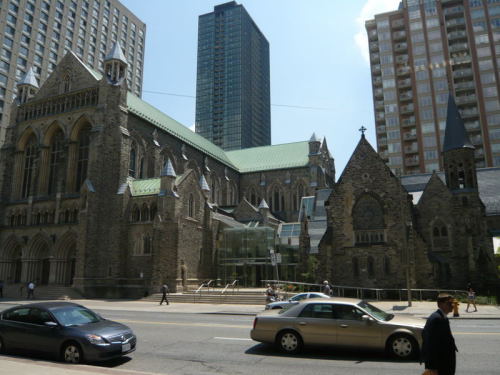
Church of GG's funeral
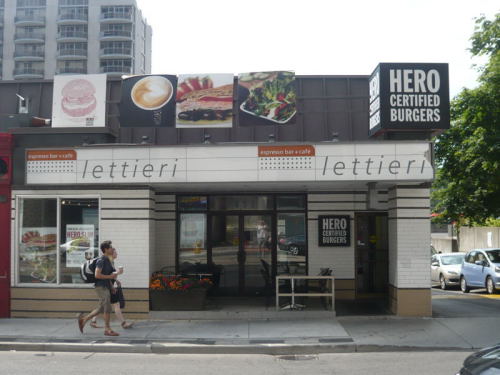
Former Fran's near Gould's home
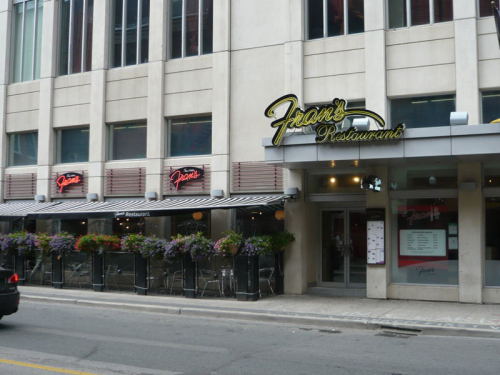
Fran's Toronto
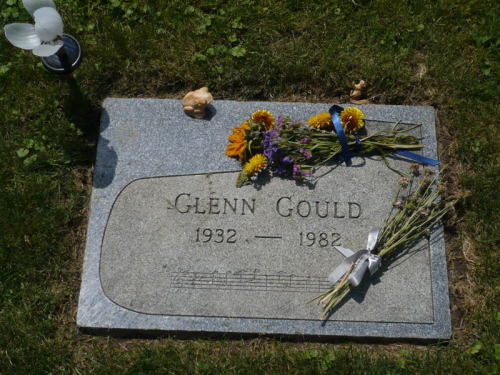
GG grave marker
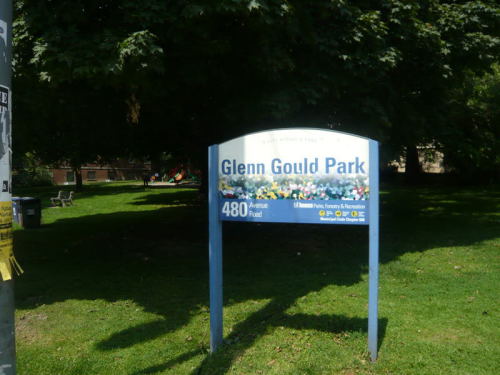
Glenn Gould Park, St. Clair Ave 1
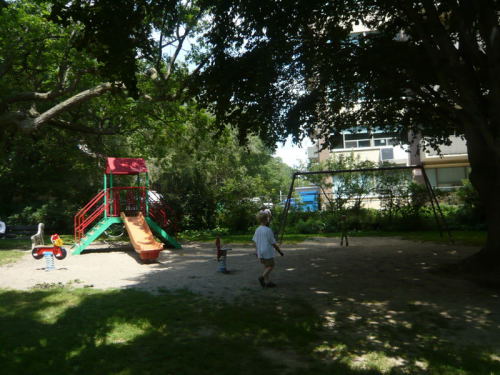
Glenn Gould Park, St. Clair Ave 2
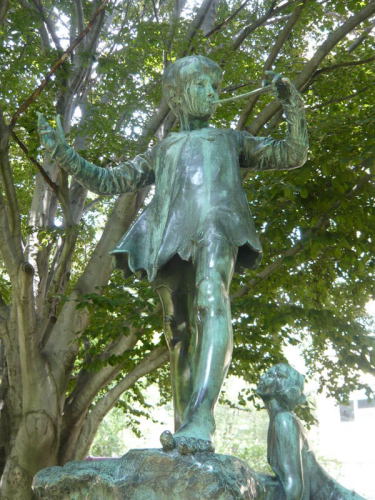
Glenn Gould Park, St. Clair Ave3 - Peter Pan statue
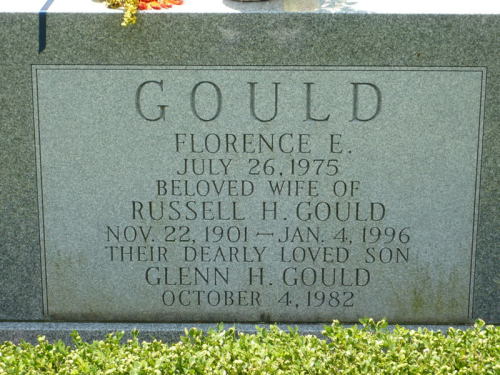
Gould family gravestone
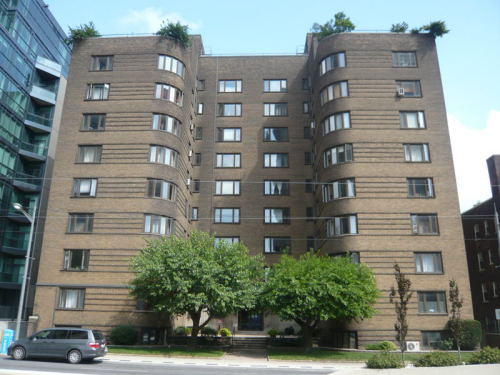
Gould's condo building
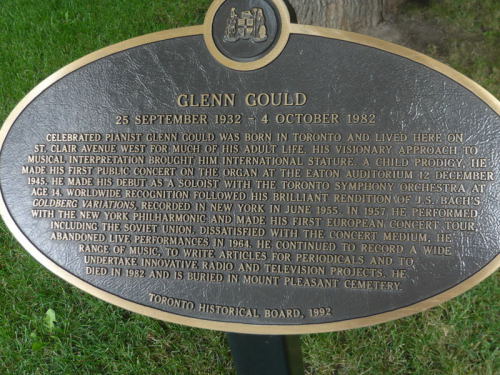
Plaque at Gould's building
 Return to Glenn Gould: A Perspective homepage
[Last updated June 13, 1996] [Last updated October 24, 2010]