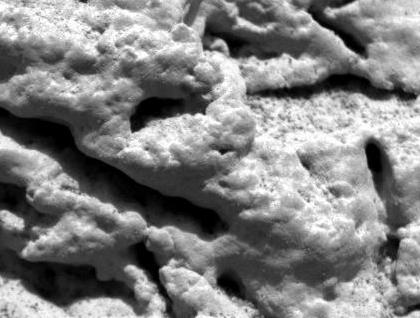
This page was developed to explore in a positive way but critically the possibility that the Mars Exploration Rovers in the spring of 2004 were able to image fossils ofnow extinct life on Mars.
There are hints that the mother rock of the Eagle crater where the Opportunity Roverfound itself had layers cemented by microbial slime and even possibly a long algae-likefilaments. That the spherules are inorganic concretions might have been accepted except that many of them seem to have a stem dimple and in some cases the stem they grew off may have been preserved.Spherules also have internal structure including the dimple and an outer crust.There are many tiny biological-looking objects found in the soil, especially a whole class of wheel-shaped objects referred here as hallucinogenia.Many other objects imaged by the rovers have been proposed as fossils andsome of these are discussed as well.
But nothing is certain and all the evidence is still ambiguous.The author is probably more skeptical about these being real biogenic fossils than most.He is perplexed by the dimples on the spherules and would assign the spherules maybe a 3 percent chance of being organically formed.His proposed microbial or algae mat has maybe a 4 percent chance of being organic.The exo-corals, and the exo-cephalopods, the rotinis and other vug objectsshould, almost certainly, be explained using non-biological processes.Corals and worms are organisms too evolutionarily advanced to hope forfor the small window of life that Mars had open.However, the importance of finding fossils on Mars is so momentous that,even with these unlikely odds, the possibility should be explored thoroughly.
I have my fingers crossed. Right now I am, we are,just squirreling around with mostly ambiguous imagesand trying to tease whatever hints about life from themthat we can. Maybe they are fossils, but likely they are not. And that is fine. I don't think fossils on Mars can be dismissed and I would like to read a critical analysis of the algae column images or the spherule dimples.One day, hopefully, the rovers may find something that was once unmistakeblyalive and send us back an unequivocal image of a fossil of some kind just winking and smiling at us and mugging for the camera. I hope these findings encourage NASA and ESA to send another rover there soon with the sort of instrumentation the the Beagle had on it to look for life instead of just water.
The NASA Rover science team mission was to find evidence of water on Mars. They found it and their proofs, images and scientific analysis were superb and they seemed to have nailed it at 100%.Their mission was not to say, "Oh, this sort of looks like a fossil, whadidja think?"That's what I am saying here. They can't say that.I notice now that they have found water, their senior scientists are relaxinga bit and will say "Wouldn't this be a good place to look for fossils?Look how well everything is preserved."To make a scientifically valuable decision about life on Mars you wouldhave to go there with a gas analysis spectrometer and do counts and ratios for isotope carbon-12 and 13 and look for amino acids and other distinctive biological signatures.Maybe they are waiting for a mission with kind of that equipment or a mission that will return some sample soil and rocks.In any case I congratulate NASA MER team and the American people on their great contribution to planetary science.
What a great pleasure and privilege to correspond with the many people who sent in challenging and intelligent comments about this page.These correspondents could often be critical yet supportive at the same time and their attachments and links showing candidate fossils were always welcome and puzzling. This site could have never been what it is without the fantastic contributionof a truly international group of collaborators -- from Puerto Rico, the U.S.A.,France, Turkey, Australia, Russia, Italy and Canada -- and likely elsewhereincluding writers on different bulletin boards and newsgroups.My sincere thanks to you all.
Best regards,
Michael
marsfossils@canada.com